Salzburg Day Trip from Munich Without a Car: A Practical 2026 Guide
Fact-checked: 22 October 2026.
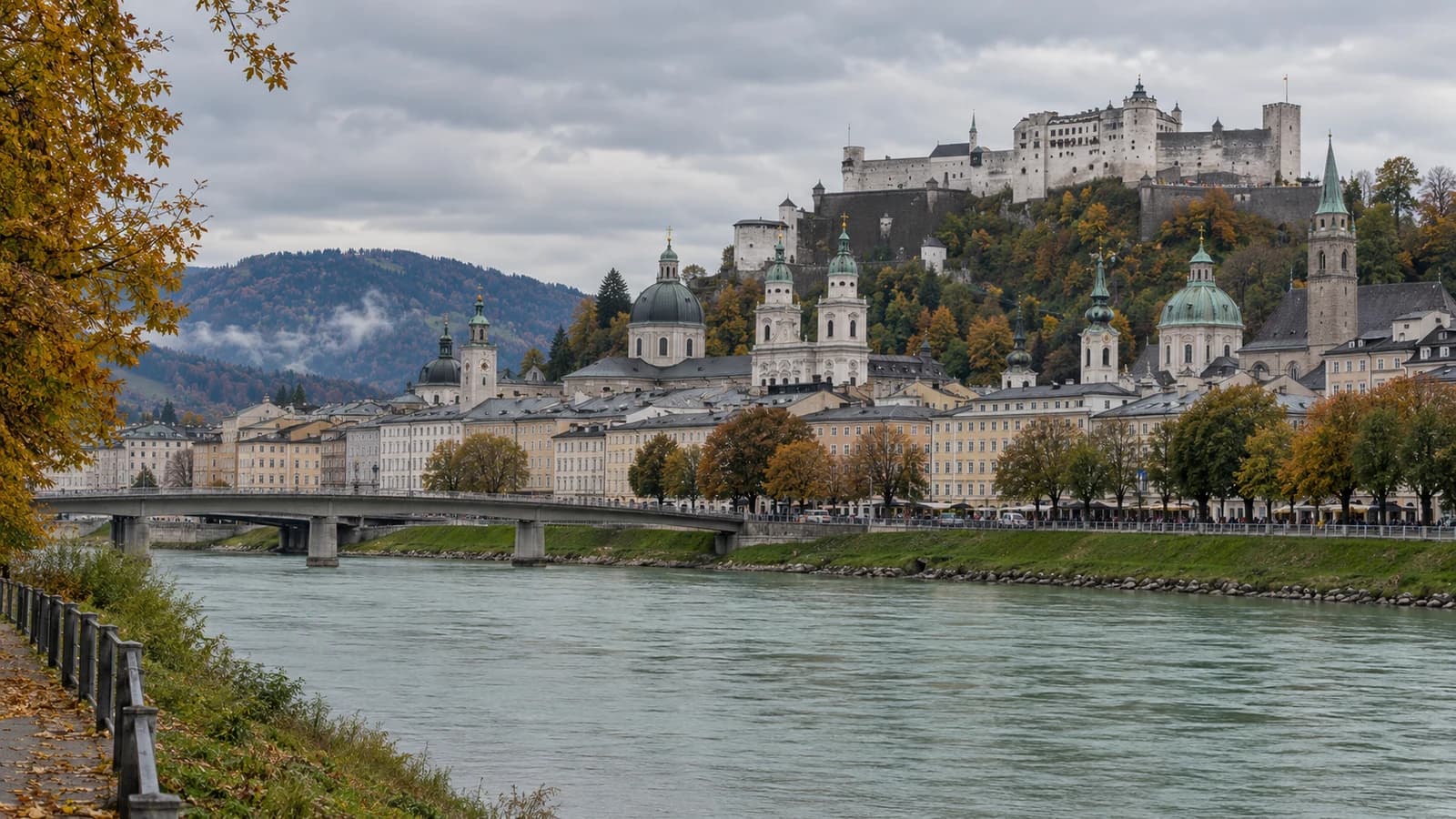
Original AI-created editorial image for REIR Journal; not an on-location photograph.
A medieval fortress overlooking a historic city, elegant gardens, narrow shopping streets and mountains rising beyond the rooftops.
Salzburg is one of Austria's most distinctive cities.
It is also a destination that travellers staying in Munich can explore without renting a car.
Regional trains connect Munich with Salzburg, and many of the city's major attractions are located within a relatively compact historic centre.
However, there are several details worth understanding before planning your journey.
Not every train ticket is valid on every service. Some regional tickets cannot be used before 9 a.m. on weekdays. Construction work may affect train schedules, and Salzburg's sightseeing passes have different benefits.
This guide explains how to travel from Munich to Salzburg, what to see in one day, which tickets to consider and whether staying overnight would improve your trip.
1. How to Get from Munich to Salzburg by Train
For travellers without a car, the train is a practical way to reach Salzburg.
One of the main regional services is the RE5, operated by Bayerische Regiobahn (BRB).
The route connects München Hauptbahnhof with Salzburg Hauptbahnhof, travelling through Rosenheim and other stations along the way.
The service provides a direct regional railway connection between the two cities.
However, the timetable is not identical every day, and construction-related changes can affect departures.
Important railway update for 2026
BRB has published timetable adjustments affecting its Chiemgau-Inntal network between June 14 and December 12, 2026.
These changes are related to major railway construction between Obertraubling and Passau, which has wider consequences for other routes.
The RE5 Munich–Salzburg service is among the affected lines.
BRB has also published additional timetable deviations for the Munich–Rosenheim–Salzburg route around October 28–November 1, 2026.
Before travelling: Check the current departure, arrival and return times for your exact date.
Do not rely on an older guide that assumes the usual regional timetable is operating without changes.
Official information: BRB — RE5 Timetable and BRB — 2026 Railway Construction Updates. BRB
2. Is the Bayern-Ticket Worth Buying?
The Bayern-Ticket is one of the most useful regional transport products to understand when planning a day trip from Munich.
It allows eligible travel on regional and local public transport services within Bavaria and on certain routes extending beyond the state.
Importantly, its validity extends to Salzburg.
However, there are restrictions.
Which trains can you use?
The Bayern-Ticket is valid on eligible regional and local trains.
It is not a general ticket for all long-distance services.
Before boarding, check whether your chosen train is included in the ticket's conditions.
For a Munich–Salzburg journey, the RE5 regional service is one option to investigate.
Validity hours and Salzburg city transport
The standard daytime Bayern-Ticket is valid Monday–Friday from 09:00 until 03:00 the following day. On weekends and applicable Bavarian public holidays, and on 24 and 31 December, it is valid from 00:00 until 03:00 the following day. Check the date-specific conditions before buying. On eligible regional services it covers travel as far as Salzburg Hbf; it does not include Salzburg city transport, including city buses. It is not valid on ICE or IC trains. This is separate from the Bayern-Ticket Nacht.
How much does it cost?
As listed by Deutsche Bahn when checked on October 22, 2026, second-class Bayern-Ticket prices include:
| Travellers | Published ticket price | |---|---:| | 1 person | €34 | | 2 people | €44 | | 3 people | €54 | | 4 people | €64 | | 5 people | €74 |
These are published ticket prices, not quotations for a particular train departure. Check current prices and conditions before purchasing.
Does the Bayern-Ticket include Salzburg city buses?
No.
Deutsche Bahn specifically states that although the Bayern-Ticket is valid as far as Salzburg, Salzburg's city buses are not included.
This is an important distinction for visitors who plan to use public transport after arriving.
Official information: Deutsche Bahn — Regional Tickets and Bayern-Ticket Rules. Deutsche Bahn
3. Getting from Salzburg Main Station to the Old Town
Your train arrives at Salzburg Hauptbahnhof, the city's main railway station.
From here, you can continue toward the historic centre on foot or by public transport.
For a sightseeing route, Mirabell Palace and its gardens make a useful first destination.
From the Mirabell area, you can continue toward the Salzach River and cross into the historic Old Town.
This creates a logical route through several major attractions without repeatedly travelling back and forth across the city.
Should you walk or take a bus?
That depends on your luggage, mobility and weather conditions.
Salzburg's tourism office describes the city as relatively compact, with many attractions accessible on foot.
If you prefer public transport, use the official Salzburg Verkehr journey planner to find a suitable connection.
Practical tip: If you are visiting for one day, avoid carrying a large suitcase around the Old Town. Check suitable luggage-storage arrangements before travelling.
Official information: Salzburg Verkehr — Journey Planner.
4. Start at Mirabell Palace and Gardens
Mirabell Palace and its gardens are among Salzburg's best-known landmarks.
The palace was originally built in 1606 and later developed into the Baroque complex visitors recognize today.
The gardens are particularly appealing because of their formal design, sculptures and views toward Salzburg's historic centre and fortress.
They also appear in the film The Sound of Music.
Is admission free?
Yes. The official Salzburg tourism website lists free admission to the Mirabell Palace and Gardens areas open to visitors.
However, the palace is also used for municipal administration, so not every room is open to the public.
The gardens are generally open daily from approximately 6 a.m. until dusk, with some seasonal restrictions.
Important update for October 2026
The official tourism website states that the Orangerie Garden is closed for redesign until December 2026.
This does not mean the entire Mirabell Gardens complex is closed.
Check which areas are accessible during your visit.
Practical tip: Mirabell is a good place to begin your day if you arrive early. If you reach Salzburg later, you may prefer to visit time-limited attractions first.
Official information: Mirabell Palace and Gardens. Salzburg
5. Explore Salzburg's Historic Old Town
After visiting Mirabell, continue across the Salzach River toward the Old Town.
Salzburg's historic centre was added to the UNESCO World Heritage List in 1996.
Its architecture, squares, churches and narrow streets reflect centuries of cultural and religious history.
The Old Town is particularly suitable for visitors who enjoy exploring a city on foot.
Getreidegasse
One of the most recognizable streets in the historic centre is Getreidegasse.
It is known for its traditional shop signs, historic buildings and narrow passages.
The street also contains one of Salzburg's most famous museums: Mozart's Birthplace.
Mozart's Birthplace
Wolfgang Amadeus Mozart was born on January 27, 1756, at Getreidegasse 9.
Today, the building contains a museum dedicated to his life and family.
Visitors can explore historic rooms, documents and exhibits connected with the composer.
According to Salzburg's official tourism website, the museum normally opens daily from 9 a.m. until 5:30 p.m., with the last admission 30 minutes before closing.
The published standard adult admission price for October 2026 is €18.
If you are particularly interested in classical music or Mozart's history, this is an attraction worth considering.
If not, you can still enjoy Getreidegasse and the surrounding streets without entering the museum.
Official information: Mozart's Birthplace — Visitor Information. Salzburg
6. Salzburg Cathedral and the Historic Squares
Continue toward Salzburg Cathedral.
The cathedral is one of the defining buildings of the historic centre.
The surrounding squares, including Residenzplatz and Kapitelplatz, provide opportunities to explore Salzburg's architecture without planning another lengthy museum visit.
Does Salzburg Cathedral charge admission?
The cathedral publishes a preservation fee for visitors.
For 2026, the standard adult preservation fee is €7.
The official website also lists reduced fees for eligible visitors.
Unlike some other Salzburg attractions, the cathedral's preservation fee is not fully waived by the Salzburg Card.
The card provides a reduction rather than automatically covering the complete admission.
Opening hours
During September and October, the cathedral's regular visiting hours are:
Monday–Saturday: 9 a.m.–6 p.m.
Sundays and public holidays: 1 p.m.–6 p.m.
Visiting is restricted during religious services and certain musical events.
Always check the official schedule before entering.
Practical tip: If you are short on time, walking around the cathedral and surrounding squares can still be worthwhile without adding another paid interior visit.
Official information: Salzburg Cathedral — Opening Hours and Admission. Salzburg
7. Visit Hohensalzburg Fortress
Hohensalzburg Fortress stands above Salzburg's historic centre.
It is one of the city's most prominent landmarks and offers views over the rooftops, river and surrounding landscape.
The fortress can be reached on foot or using the FestungsBahn funicular.
Should you walk or take the funicular?
Walking involves an uphill route.
The funicular provides an alternative for visitors who prefer not to climb.
Its lower station is located at Festungsgasse 4 in the Old Town.
According to the official tourism website, the funicular has operated since 1892.
Opening hours in October 2026
The fortress's published regular opening hours for October are 9:30 a.m.–5 p.m.
The final admission is half an hour before closing.
Different ticket categories are available, and the inclusions depend on the ticket selected.
Important ticket distinction
The Salzburg Card includes a qualifying fortress visit and funicular benefit.
However, the Guest Mobility Ticket provided to overnight visitors does not cover the fortress funicular.
These are different products.
Practical tip: If you are arriving in Salzburg around midday, consider visiting the fortress before spending too much time exploring shops and cafés. Its closing time can determine the rest of your itinerary.
Official information: Hohensalzburg Fortress and FestungsBahn Funicular. Salzburg
8. A Realistic One-Day Salzburg Itinerary
A good day trip should leave enough time for sightseeing without making every stop feel rushed.
The following route is designed around the main railway station and Salzburg's historic centre.
Arrival: Salzburg Hauptbahnhof
Arrive using a suitable train from Munich.
If you are travelling with a Bayern-Ticket on a regular weekday, remember that its standard validity begins at 9 a.m.
This may mean reaching Salzburg later than visitors who travel with a different ticket or arrive on a weekend.
First Stop: Mirabell Gardens
Walk or take public transport toward Mirabell.
Explore the accessible garden areas and enjoy the views.
If you have arrived relatively late, consider moving the fortress earlier in your schedule instead.
Next: Cross into the Old Town
Continue across the Salzach River.
Explore Getreidegasse and the surrounding streets.
If Mozart's Birthplace interests you, allow time for a museum visit.
Otherwise, continue toward the cathedral and historic squares.
Main Attraction: Hohensalzburg Fortress
Make your way toward the fortress.
Choose between the uphill walking route and the funicular.
Allow enough time to explore before the published closing hour.
Late Afternoon: Explore at Your Own Pace
After visiting the fortress, continue through the Old Town.
You could return to the river, explore additional streets or stop for a meal.
Avoid adding another attraction simply because it appears on a list of things to see.
Return to Munich
Make your way back to Salzburg Hauptbahnhof.
Check the departure and any disruption notices for your chosen return service.
Recommended approach: Prioritize the fortress and one additional indoor attraction if you want a manageable day. Leave time for Salzburg's streets and squares rather than rushing between museums.
9. Is the Salzburg Card Worth It?
The Salzburg Card is a sightseeing pass that combines admission benefits with eligible local public transport.
It is different from the Bayern-Ticket, which is primarily relevant to regional travel from Munich.
Published 2026 Salzburg Card prices
| Validity | April–October | November–December | |---|---:|---:| | 24 hours | €38 | €35 | | 48 hours | €45 | €41 | | 72 hours | €49 | €44 |
These are the published adult prices for the stated 2026 periods.
The card provides one-time admission to participating attractions and other benefits, subject to the operator's conditions.
Should you buy it for a day trip?
It depends on your plans.
If you want to visit the fortress, Mozart's Birthplace and several other participating attractions, compare the card's price with the individual admissions.
If you mainly want to explore the Old Town and Mirabell Gardens, you may not need a sightseeing pass.
Important: Do not assume every attraction is completely free with the card. Salzburg Cathedral, for example, publishes a reduced preservation fee for cardholders.
Official information: Salzburg Card — Official 2026 Prices. Salzburg
10. Should You Stay Overnight in Salzburg?
A day trip from Munich is practical, but staying overnight can provide a more relaxed experience.
It may be particularly worthwhile if you want to visit several museums, spend more time exploring the Old Town or avoid planning your day around a return train.
Where should you look for accommodation?
Salzburg Old Town: A useful area to investigate if you want to be close to historic streets, the cathedral and major sightseeing attractions.
Mirabell and the right bank of the Salzach: Worth considering if you want access to the gardens and a location between the railway station and historic centre.
Near Salzburg Hauptbahnhof: A practical option if easy railway access is your main priority, particularly for early departures or luggage-heavy travel.
Before booking, check the hotel's actual address, walking distance to transport and cancellation conditions.
An important benefit for overnight guests
Since May 2025, Salzburg has operated a Guest Mobility Ticket programme.
Eligible overnight guests receive a ticket allowing public transport use throughout the Salzburg region during their stay.
The programme is financed through a mobility fee.
As of October 2026, the published mobility fee is €0.50 per person per night for guests aged 15 and over.
The ticket can be provided digitally, and accommodation providers may be able to send it before arrival.
However, its validity is limited to the relevant Salzburg transport area. It should not be treated as a ticket for the entire journey from Munich.
Practical tip: If you plan to stay overnight, ask your accommodation provider how and when the Guest Mobility Ticket will be issued.
Official information: Salzburg Guest Mobility Ticket. Salzburg
11. How REIR Can Help You Compare Salzburg Hotels
If you decide to stay overnight, choosing the right accommodation becomes an important part of your trip.
With REIR, you can search for a hotel and compare available offers from different booking providers.
Before choosing an offer, review the total price, room category, cancellation terms and included services.
REIR also offers Hotel Watch, a free monitoring feature that can follow a selected hotel for up to seven days or until check-in, whichever comes first.
If a qualifying price drop is detected during active monitoring, REIR can notify you by email.
Hotel Watch does not guarantee that prices will decrease and does not automatically modify an existing reservation.
Search and Compare Hotels with REIR
Frequently Asked Questions
Can you visit Salzburg from Munich without a car?
Yes. Regional trains connect Munich with Salzburg, and many attractions in Salzburg's historic centre can be explored on foot.
Is the Bayern-Ticket valid to Salzburg?
Yes. On eligible regional services it is valid as far as Salzburg Hbf. Salzburg city transport, including city buses, is not included.
Can you use the Bayern-Ticket before 9 a.m.?
On ordinary weekdays the standard daytime ticket is valid 09:00–03:00 the following day. On weekends, applicable Bavarian public holidays and 24 and 31 December, it is valid 00:00–03:00 the following day.
Is Salzburg worth visiting for one day?
Yes. A day trip can provide time to explore the historic centre and selected attractions. Visitors who want several museum visits may prefer an overnight stay.
Are Mirabell Gardens free?
Yes. Admission to the accessible Mirabell Gardens areas is free, although some sections may be closed temporarily or seasonally.
Does the Salzburg Card include Hohensalzburg Fortress?
Yes, the card includes a qualifying one-time fortress visit and funicular benefit, subject to its conditions.
Does the Guest Mobility Ticket include the train from Munich?
No. The Guest Mobility Ticket applies to eligible public transport within the Salzburg region, not the entire international journey from Munich.
Where should you stay in Salzburg?
The Old Town, Mirabell area and neighbourhoods near the main railway station are useful starting points. The best choice depends on your sightseeing plans and transport needs.
Final Thoughts
Salzburg is a destination where thoughtful planning can make a short visit much easier.
A direct regional railway connection makes it possible to travel from Munich without renting a car.
Once you arrive, the historic centre offers a combination of architecture, museums, gardens and scenic viewpoints.
The most important decisions are choosing a suitable train ticket, checking current railway disruptions and prioritizing attractions with limited opening hours.
For a day trip, focus on a manageable route.
For a longer visit, consider staying overnight and exploring Salzburg at a slower pace.
Official sources
- BRB — RE5
- BRB — 2026
- DB — Bayern-Ticket
- DB — Salzburg / Bayern-Ticket
- Salzburg Verkehr
- Mirabell
- UNESCO — Salzburg
- Mozart
- Salzburger Dom
- Hohensalzburg
- FestungsBahn — FAQ
- Salzburg Card — 2026
- Guest Mobility Ticket